Key Takeaways
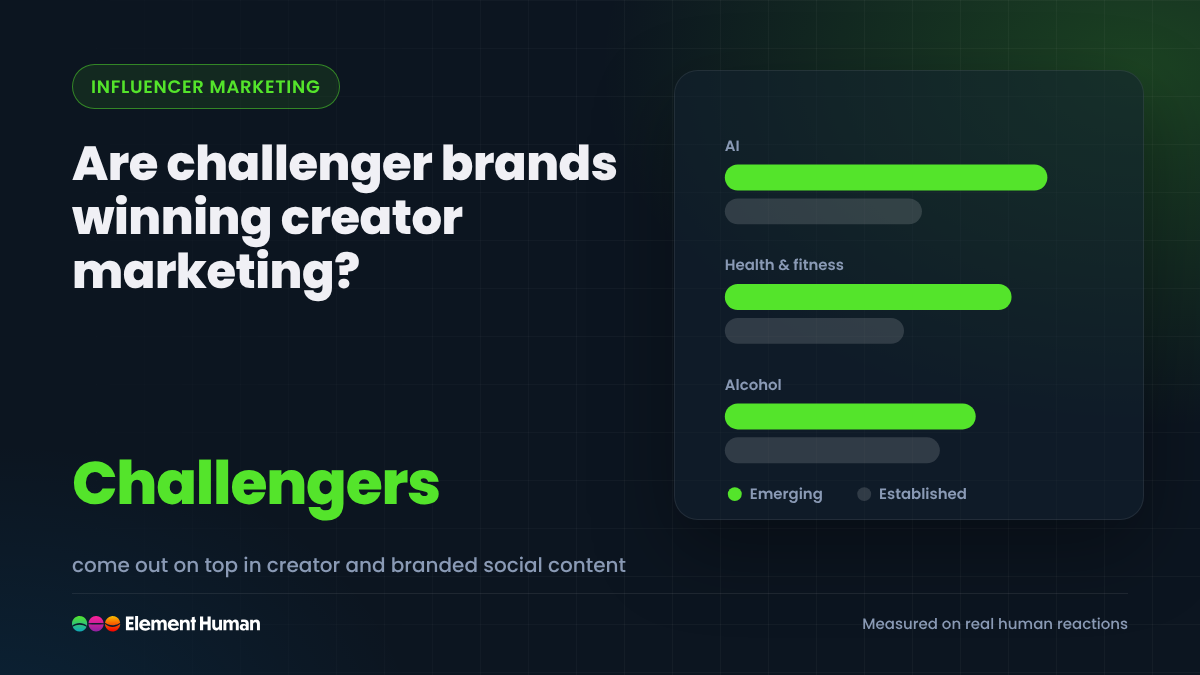
- Comparing emerging and established brands across categories, challengers come out on top in creator and branded social content.
- Emerging AI brands top the chart on both stopping the scroll and building long-term brand memory.
- In health and fitness and in alcohol, emerging brands outperform established ones on both measures.
- Established fashion brands sit bottom of the pile, below average on both measures.
- In crowded categories, fame alone doesn't get the job done. Being different does.
The usual assumption in creator marketing is that big brands have the advantage. More budget, more recognition, more creators wanting to work with them. If anyone should win the scroll, it should be them.
Our data says otherwise. When we compare emerging and established brands across categories, the challengers come out on top, both at stopping the scroll and at getting the brand into long-term memory.
How do we compare challenger and established brands?
We use Stopping & Staying Power, which scores every piece of creator and branded social content on two questions.
- Stopping Power: does the content stop the scroll? We measure how long people keep it on screen in a lifelike social feed.
- Staying Power: does the brand stick? We measure how much faster people link the brand to the right traits after seeing the content, compared with a control group.
Plot both and you can see which brands are being seen and remembered, which are seen but forgotten, and which are struggling on both. Read more about how Stopping & Staying Power works.
Which category is winning creator marketing?
AI is the standout. Emerging AI brands top the chart on both measures: their content holds attention and builds memory better than any other category.
This lines up with what we see on attention alone. In our wider data on creator videos, AI brands are among the strongest categories for holding attention on TikTok. See attention by category and platform.
Do challenger brands beat incumbents head to head?
Yes, in the categories where we can compare them directly. In health and fitness and in alcohol, emerging brands outperform established ones on both stopping the scroll and sticking in memory.
- Emerging AI brandsTop of the whole chart
- ✓ Stopping Power
- ✓ Staying Power
- Health & fitnessEmerging beat established
- ✓ Stopping Power
- ✓ Staying Power
- AlcoholEmerging beat established
- ✓ Stopping Power
- ✓ Staying Power
Source: Element Human Stopping & Staying Power data, creator and branded social content.
Challengers have a reason to be noticed. New product, new story, new face. That gives creators something genuinely new to say, and gives audiences a reason to stop and remember.
Why are established fashion brands struggling?
Fashion has a saturation problem. Established fashion brands sit bottom of the pile, below average on both stopping the scroll and building memory.
When feeds are already full of outfit hauls, try-ons and styling videos, even the biggest names struggle to stand out. More of the same just blends in. Our attention data tells the same story: fashion creator videos hold the least attention per thousand impressions of any major category, on both TikTok and Instagram.
What should established brands do about it?
- Stop relying on the logo. Fame gets you into the feed, not into memory. Give creators something new to say.
- Break the category format. If every brand in your category posts the same type of video, do something else.
- Measure both jobs. Track stopping power and staying power for every creator video, and upweight the ones that do both.
- Learn from challengers. Look at what emerging brands in your category are doing differently, and test it.
In crowded categories, fame alone doesn't get the job done in creator marketing. Challenger brands are finding success by being unique and different from the incumbents.
How we measured this
For this analysis we compared creator and branded social content from emerging and established brands, tested in our simulated social feeds. Stopping Power is measured as in-feed attention (dwell time); Staying Power is measured with a timed implicit association test against a control group, with around 150 exposed viewers and 100 control viewers per test. Element Human also tests brand ads as well as creator content, across social feeds (TikTok, Instagram, Facebook and YouTube Shorts), CTV pre-rolls and sponsorships in simulated Netflix and Prime Video environments, and standalone video such as TV ads. Every test compares an exposed group with a control group of people who did not see the content.
About the author
Hamish McPharlin is Chief Customer Officer at Element Human, where he helps brands prove and optimise the impact of their advertising. He previously worked at the BBC and CNN. Follow Hamish on LinkedIn.
Want to gather your own insights?
Ellie is Element Human's AI connector. Ask it about attention, emotion and brand memory, and get answers from real human reaction data.
Try Ellie