Key Takeaways
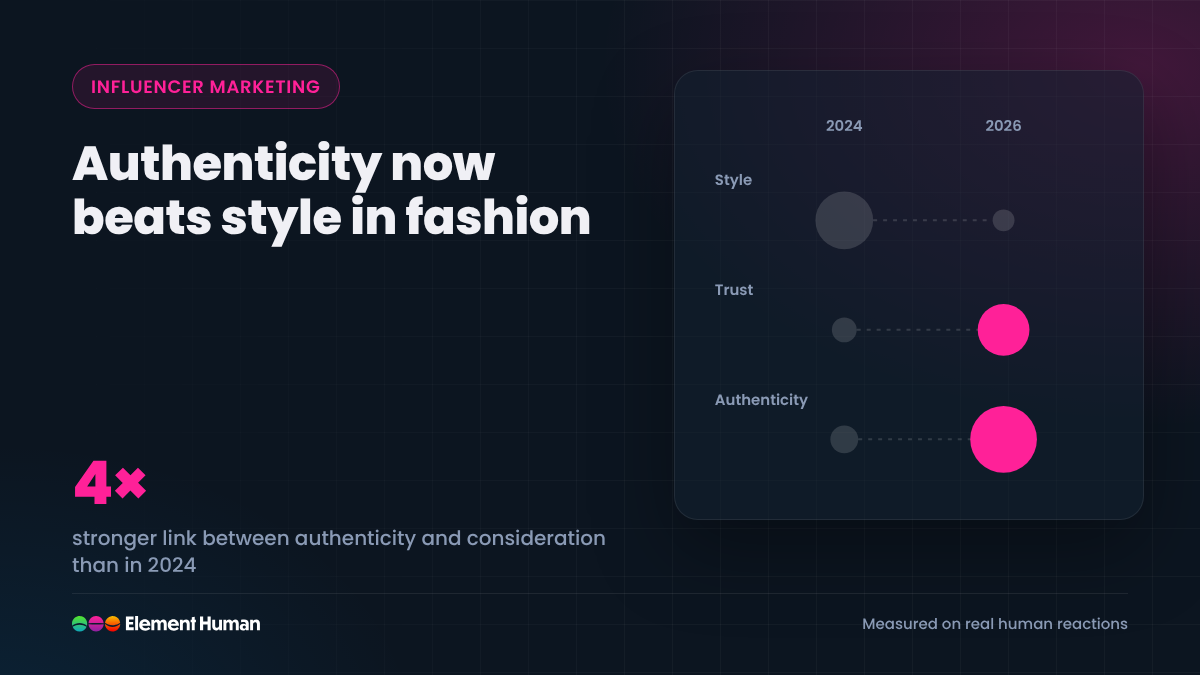
- In 2024, being seen as stylish was linked to brand consideration for fashion creator content. In 2026 that link has all but disappeared.
- Authenticity is now the strongest driver of consideration, more than four times stronger than in 2024.
- Trust has gone from barely moving consideration in 2024 to being essential in 2026.
- Emotional expressiveness while watching fashion creator content has risen by around 40% since 2024, even for the same brands.
- In a feed full of perfectly styled content, looking good is the baseline. Real people, real emotion and trust are what win.
For years the brief for a fashion creator was simple: make it look good. Great styling, great light, a clean edit. If the outfit looked aspirational, the brand would follow.
Our data says that brief is out of date. When we compare what drives brand consideration after people watch fashion creator content in 2024 and in 2026, the picture has flipped. Style has lost its pull. Authenticity and trust have taken its place.
What drives consideration for fashion creator content in 2026?
Authenticity is now the strongest driver of brand consideration for fashion creator content, more than four times stronger than it was in 2024.
- Link between authenticity and considerationMore than 4×
- Emotional expressiveness while watchingAbout +40%
Source: Element Human fashion creator tests, 2024 vs 2026, including the same brands in both years.
We measure this with implicit association testing. After watching the content, people answer timed questions about which traits they link to the brand. The speed of a "yes" tells us how firmly that link sits in long-term memory. We then look at which of those traits move alongside consideration. In 2026, the trait that matters most is authentic.
Why has "stylish" stopped working?
In 2024, being seen as stylish was linked to consideration. Now that link has all but disappeared.
My read is that style has become table stakes. Scroll any feed and almost everything is well shot, well styled and well lit. When every video looks good, looking good stops being a reason to pick one brand over another. It is the baseline, not the differentiator.
Why does trust matter more now?
Trust has gone from irrelevant to essential. In 2024 it barely moved consideration. In 2026 it does.
For fashion brands that matters, because trust is built by the people telling the story as much as by the brand. A creator who talks honestly about fit, quality or how they actually wear something gives the audience a reason to believe, not just a reason to look.
Are audiences feeling more when they watch fashion content?
Yes. Emotional expressiveness while watching fashion creator content has risen by around 40% since 2024, even for the same brands.
We track this with facial coding, second by second, while people watch. More expression means content is landing on a more emotional level. Put that next to the shift towards authenticity and trust and a clear pattern appears: audiences are rewarding content that feels real and makes them feel something.
How to brief fashion creators for 2026
- Treat style as the baseline. Keep production quality, but stop treating it as the idea.
- Brief for honesty. Ask creators to talk about how the product really fits, feels and lasts, in their own words.
- Pick creators people believe. Choose creators whose audience trusts their opinion, not just their look.
- Leave room for emotion. Humour, surprise or a personal story give people something to feel, and something to remember the brand by.
- Measure trust and authenticity, not just reach. Track which traits your brand is building, and whether they are the ones that drive consideration.
In a feed full of perfectly styled content, looking good is the baseline. What wins is real people, real emotion and trust.
How we measured this
For this analysis we compared fashion creator content tested in 2024 with fashion creator content tested in 2026, using implicit association testing (the timed "Fast Yes" measure of brand memory) and webcam-based facial coding of emotional expression, with around 150 exposed viewers and 100 control viewers per test. Element Human also tests brand ads as well as creator content, across social feeds (TikTok, Instagram, Facebook and YouTube Shorts), CTV pre-rolls and sponsorships in simulated Netflix and Prime Video environments, and standalone video such as TV ads. Every test compares an exposed group with a control group of people who did not see the content.
About the author
Hamish McPharlin is Chief Customer Officer at Element Human, where he helps brands prove and optimise the impact of their advertising. He previously worked at the BBC and CNN. Follow Hamish on LinkedIn.
Want to gather your own insights?
Ellie is Element Human's AI connector. Ask it about attention, emotion and brand memory, and get answers from real human reaction data.
Try Ellie