Key Takeaways
- For one entertainment brand, creator videos beat the brand's own social videos with the same audience on every brand outcome we measured.
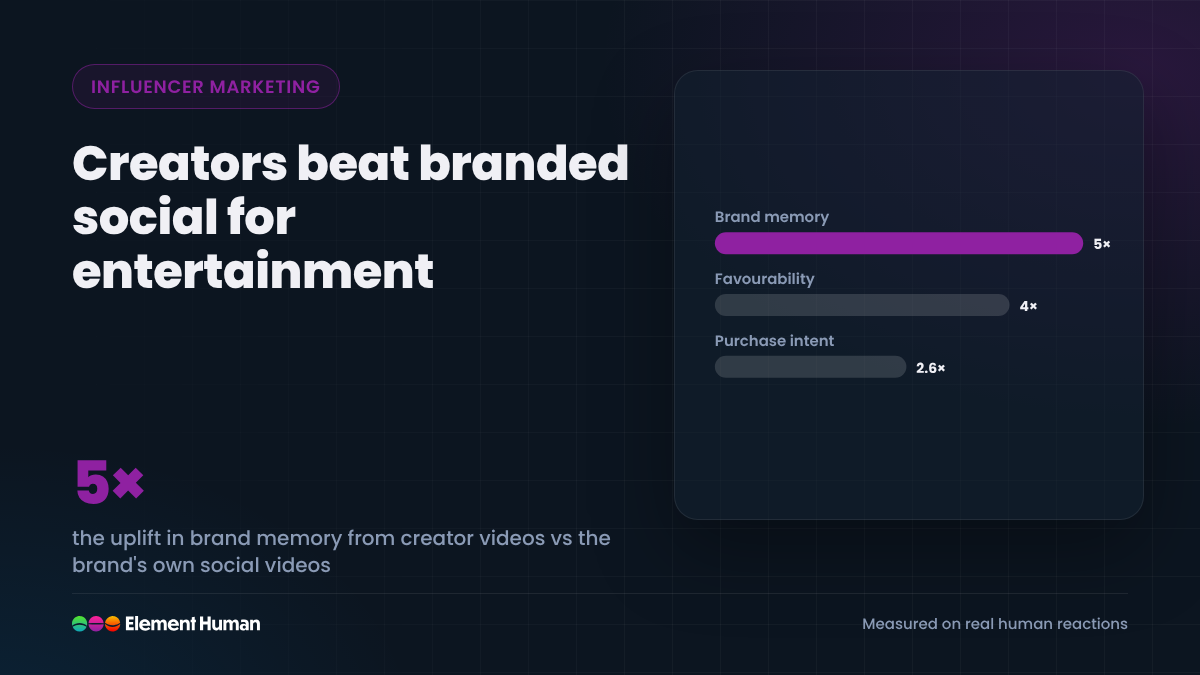
- Creators drove 2.6x the uplift in purchase intent, 4x the uplift in favourability and 5x the uplift in brand memory.
- The creator videos reached top-tier Stopping & Staying Power, at the 85th percentile on both.
- Keep it under 30 seconds: longer videos hold attention well, but shorter ones do a better job of getting the brand into memory.
- Go for strong emotions and lead with tension: the more intensely people react, the better they remember, and suspense does the most to shape how people see the brand.
Entertainment is a category built on feeling something. So when an entertainment brand takes its message to social, who should be holding the camera: the brand, or creators?
We opened the Element Human data to find out. Our brief was to compare creator videos with an entertainment brand's own social videos: same brand, same audience.
Do creator videos beat branded social for entertainment brands?
Yes, and not by a little. Putting the entertainment message in the hands of creators beat branded social across the board.
- 2.6×the uplift in purchase intent
- 4×the uplift in favourability
- 5×the uplift in brand memory
Source: Element Human tests of one entertainment brand's creator videos and its own social videos, with the same audience.
The creator videos didn't just move the brand. They earned their place in the feed too, with top-tier Stopping & Staying Power: the 85th percentile on both. They stopped the scroll, and the brand stuck.
How long should entertainment creator videos be?
Keep it under 30 seconds. Longer videos hold attention well, but shorter ones ultimately do a better job of getting the brand into memory.
That fits a wider pattern in our data. Entertainment is the exception to the rule that most brands cut their creator videos too short. Read the video length analysis.
Which emotions work best for entertainment brands?
Strong ones. The more intensely people react, the better they remember. Mild amusement is not the goal here.
And lead with tension. Suspense and edge do the most to shape how people see the brand. Every great thriller knows it. We've seen the same thing in our work on trust, where fear and tension build trust for entertainment brands. Read the emotion and trust analysis.
What should entertainment marketers do?
- Hand creators the message. With the same audience, creator videos beat the brand's own social videos on purchase intent, favourability and brand memory.
- Keep it under 30 seconds. Hold attention, then get out while the brand is still landing in memory.
- Aim for intensity, not just enjoyment. Brief creators for reactions people actually feel.
- Lead with tension. Suspense and edge shape how people see the brand.
Creators don't just entertain. They come with a licence to thrill.
How we measured this
For this analysis we compared creator videos with an entertainment brand's own social videos, shown to the same audience in our simulated social feeds. We measured attention in the feed, emotion through facial coding, and brand outcomes (purchase intent, favourability and the "Fast Yes" implicit measure of brand memory) against a control group, with around 150 exposed viewers and 100 control viewers per test. Element Human also tests brand ads as well as creator content, across social feeds (TikTok, Instagram, Facebook and YouTube Shorts), CTV pre-rolls and sponsorships in simulated streaming environments, and standalone video such as TV ads. Every test compares an exposed group with a control group of people who did not see the content.
About the author
Hamish McPharlin is Chief Customer Officer at Element Human, where he helps brands prove and optimise the impact of their advertising. He previously worked at the BBC and CNN. Follow Hamish on LinkedIn.
Want to gather your own insights?
Ellie is your decision partner for marketing. Ask about attention, emotion and brand memory inside Claude, ChatGPT or Gemini Enterprise, and get answers from real human reaction data.
Try Ellie