Key Takeaways
- We compared creator videos and brands' own posts for the same brands on TikTok and Instagram.
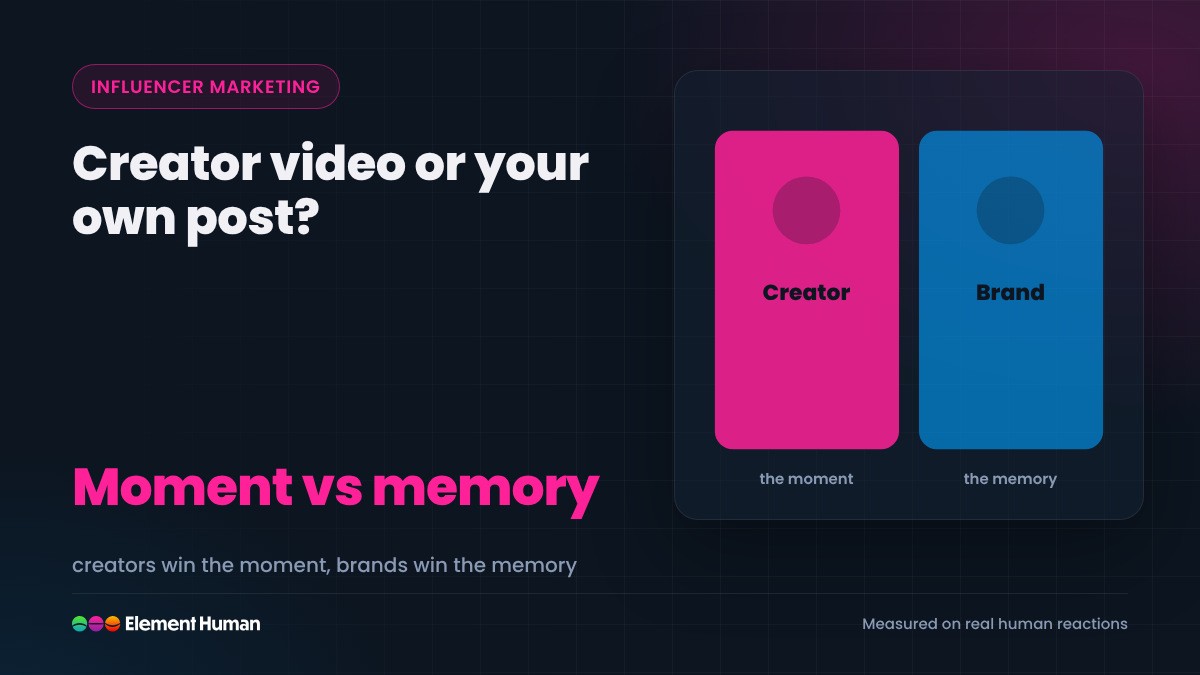
- Creators win the moment: people light up more when a creator tells your story.
- Brands win the memory: when people smile at your own content, your brand sticks. When they smile at a creator, the creator keeps the credit.
- On wanting to buy, both creator and brand content can deliver.
- If you hand the camera to a creator, put your brand inside the moment people feel something.
Creator video or your own branded post: which is better? We get asked this all the time. So we put them head to head, with the same brands on TikTok and Instagram, and watched how real people reacted.
Here's the twist: your creator might be getting the smile, while your brand misses out on the credit.
Do creators get a bigger emotional reaction than brands?
Yes. Creators win the moment. People light up more when a creator tells your story than when the brand tells it itself.
That fits what creators are for. They bring personality, a familiar face and a voice the audience already likes. We see it in the facial coding: more smiles, more expression.
So why doesn't the brand always benefit?
Because brands win the memory. When people smile at a brand's own content, the brand sticks. When they smile at a creator, the creator keeps the credit.
- Creator videoWins the moment
More smiles and more expression. But when people smile at a creator, the creator keeps the credit.
- Brand-owned postWins the memory
When people smile at the brand's own content, the brand sticks.
Both can move purchase intent. Source: Element Human facial coding and implicit memory tests.
This is a form of misattribution. The positive feeling is real, but it gets attached to the person on screen, not to the brand paying for the post. You can get a great reaction and still leave little behind for the brand. More on misattribution.
Which is better for purchase intent?
Both can deliver. When it comes to wanting to buy, creator content and brand-owned content can both move people.
So this isn't an argument against creators. It's an argument for using them well.
How to make sure your brand gets the credit
- Don't tack the brand on at the end. A logo or a product shot after the punchline is easy to forget.
- Put the brand inside the moment. Make sure the brand is on screen, named or in use at the point people feel something.
- Run both. Use creators for reach and emotion and your own content to build brand memory, and measure each on both.
- Measure memory, not just reaction. A smile is not a result until you know who got the credit.
So if you're handing the camera to a creator, don't just tack your brand on at the end. Put it right inside the moment people feel something.
How we measured this
For this analysis we compared creator videos with brands' own posts for the same brands, tested in our simulated TikTok and Instagram feeds. Emotional response was measured with webcam-based facial coding, brand memory with implicit association testing, and purchase intent by survey, each against a control group. Element Human also tests brand ads as well as creator content, across social feeds (TikTok, Instagram, Facebook and YouTube Shorts), CTV pre-rolls and sponsorships in simulated Netflix and Prime Video environments, and standalone video such as TV ads. Every test compares an exposed group with a control group of people who did not see the content.
About the author
Hamish McPharlin is Chief Customer Officer at Element Human, where he helps brands prove and optimise the impact of their advertising. He previously worked at the BBC and CNN. Follow Hamish on LinkedIn.
Want to gather your own insights?
Ellie is Element Human's AI connector. Ask it about attention, emotion and brand memory, and get answers from real human reaction data.
Try Ellie