Key Takeaways
- In social and influencer video, the emotion you trigger can build trust or cost it.
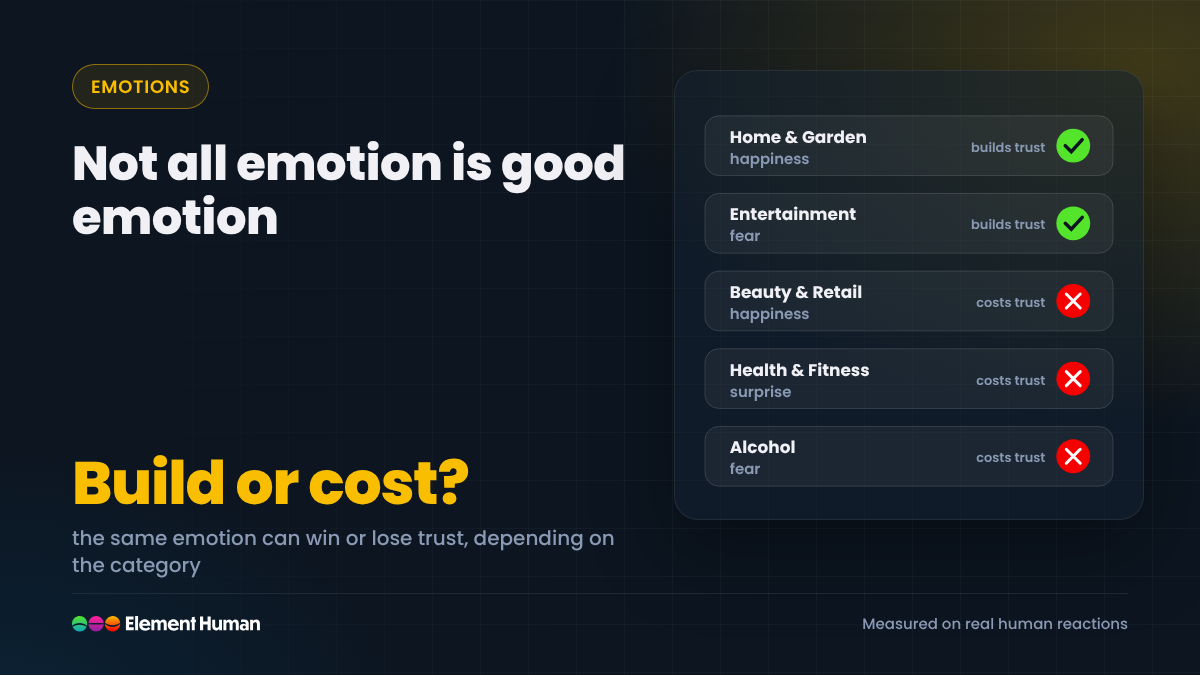
- Home & Garden: happiness builds trust. Entertainment: fear builds trust.
- Beauty & Retail: happiness slightly lowers trust.
- Health & Fitness: surprise erodes trust; calm reassures. Alcohol: fear costs trust.
- Choosing tone is a strategic decision for each category, and the wrong choice can undo the trust you are trying to build.
Most of us work on a simple assumption: if a social or influencer video makes people feel something, it's working. More emotion, more impact.
When it comes to trust, our data says that is not safe. The emotion you trigger can just as easily cost you as help you.
Does emotion in social video always build brand trust?
No. The same emotion can build trust in one category and erode it in another. The right tone depends on what you are selling.
- Builds trustLean into it
- Home & Garden: happiness
- Entertainment: fear
- Costs trustHandle with care
- Beauty & Retail: happiness
- Health & Fitness: surprise
- Alcohol: fear
Source: Element Human facial coding and brand trust measurement, social and influencer video.
Where does emotion build trust?
- Home & Garden: happiness. Smiles make people trust the brand more.
- Entertainment: fear. Make them feel it, and trust follows.
Where does emotion backfire?
- Beauty & Retail: happiness slightly lowers trust. Smiles alone don't sell credibility.
- Health & Fitness: surprise erodes trust. In this category, calm reassures.
- Alcohol: fear costs trust. The same edge that works for entertainment hurts here.
How should you choose the emotional tone of a creator brief?
Emotional tone isn't neutral. Choosing it is a strategic decision for each brand category, and the wrong choice can undo the very thing you are trying to build.
- Start from the category, not the trend. What works for an entertainment launch can hurt an alcohol brand.
- Decide which emotion you want before you brief. Put it in the brief, and say which emotions to avoid.
- Measure emotion and trust together. A big emotional reaction is only good news if trust moves the right way too.
This sits alongside our earlier finding on funny vs serious creator content: tone is a category decision, not a house style.
How we measured this
For this analysis we used social and influencer videos, measured with webcam-based facial coding (second by second, for emotions such as happiness, surprise and fear) and brand trust measured against a control group, with around 150 exposed viewers and 100 control viewers per test. Element Human also tests brand ads as well as creator content, across social feeds (TikTok, Instagram, Facebook and YouTube Shorts), CTV pre-rolls and sponsorships in simulated streaming environments, and standalone video such as TV ads. Every test compares an exposed group with a control group of people who did not see the content.
About the author
Hamish McPharlin is Chief Customer Officer at Element Human, where he helps brands prove and optimise the impact of their advertising. He previously worked at the BBC and CNN. Follow Hamish on LinkedIn.
Want to gather your own insights?
Ellie is your decision partner for marketing. Ask about attention, emotion and brand memory inside Claude, ChatGPT or Gemini Enterprise, and get answers from real human reaction data.
Try Ellie