Key Takeaways
- Most creator pricing fixes, from price databases to AI calculators, assume a view is a view.
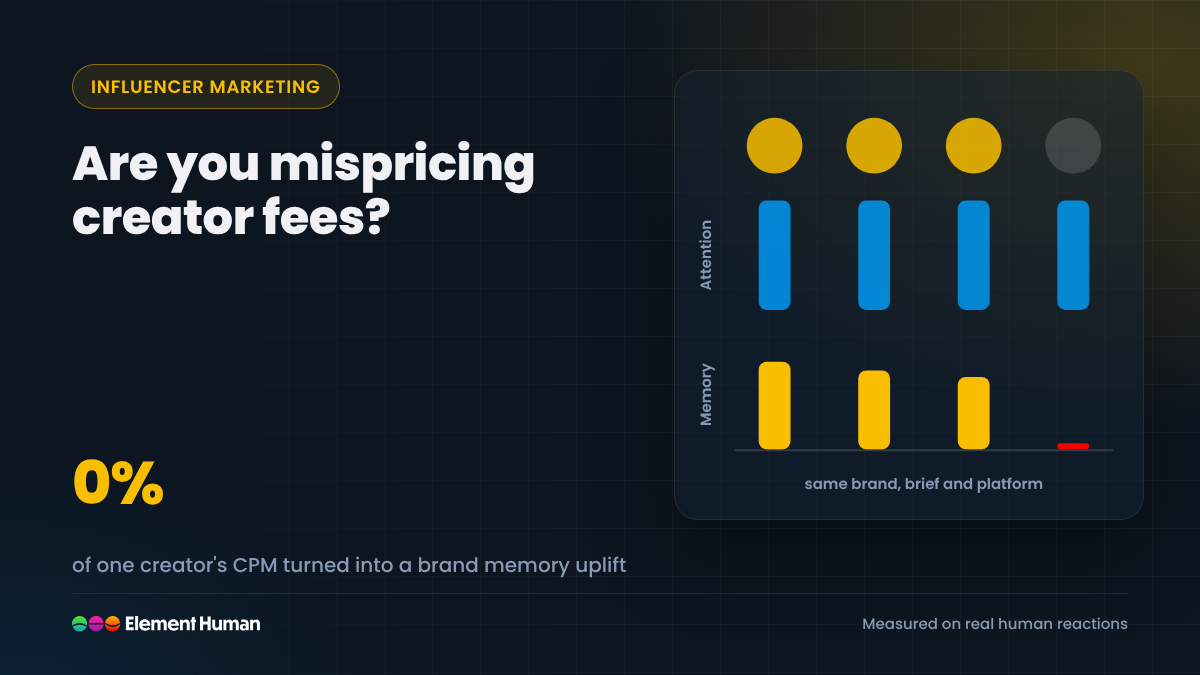
- In one TikTok campaign we tested four creators with the same brand, brief and platform. Attention was nearly identical.
- One creator produced almost no emotional response and zero brand memory uplift: 0% of their CPM turned into a brand metric.
- The other three drove 4 to 6% uplift: four to six in every hundred viewers left with a brand memory they didn't have before.
- Content with high brand memory carries a 43% purchase intent uplift in our data. You fix pricing by measuring what the price buys.
Creator pricing is a known problem. Half of marketers admit they misprice creator fees, and 40% believe they have overpaid, according to recent reporting by Digiday. The fixes on offer are price databases, benchmarks and AI calculators.
Every one of those fixes assumes a view is a view. Our data says it isn't.
Do creators with the same views deliver the same results?
No. We tested four creators in one TikTok campaign. Same brand, same brief, same platform. Attention was nearly identical: everyone got "the view".
The results were not identical at all.
- One creator produced almost no emotional response and zero brand memory uplift. Not low. Zero. That means 0% of their CPM converted into a brand metric.
- The other three drove 4 to 6% uplift. Four to six in every hundred viewers left with a brand memory they didn't have before.
All four invoiced for the same view. Only three delivered something that sells product. The fourth simply wasn't the right creator for this campaign.
- 4creators tested with the same brand, brief and platform
- 4–6%brand memory uplift from three of the creators
- 0%of the fourth creator's CPM turned into a brand metric
- 43%uplift in purchase intent for content with high brand memory
Source: Element Human test of one TikTok campaign; purchase-intent figure from Element Human creator data.
Why does brand memory matter for creator pricing?
Because brand memory is the audience purchase intent gets built from. In our data, content with high brand memory carries a 43% uplift in purchase intent.
A view tells you someone saw the content. Brand memory tells you whether they left with something that will make them more likely to buy. That's what the fee should be paying for.
How should brands price creator fees?
- Stop comparing prices alone. Two creators at the same CPM can deliver completely different value.
- Measure what the view buys. Track emotional response and brand memory uplift for each creator, against a control group.
- Price on outcomes. Work out the cost per person who leaves with a new brand memory, not just the cost per thousand views.
- Use it for selection. Feed the results into who you brief next time. The wrong creator for one campaign may be right for another.
You can't fix pricing by comparing prices. You fix it by measuring what the price actually buys.
How we measured this
For this analysis we tested four creators in a single TikTok campaign in our simulated TikTok feed, with the same brand and brief. Attention is in-feed dwell time; emotion is webcam-based facial coding; brand memory is implicit association uplift against a control group. Element Human also tests brand ads as well as creator content, across social feeds (TikTok, Instagram, Facebook and YouTube Shorts), CTV pre-rolls and sponsorships in simulated Netflix and Prime Video environments, and standalone video such as TV ads. Every test compares an exposed group with a control group of people who did not see the content.
About the author
Matt Celuszak is CEO of Element Human. Follow Matt on LinkedIn.
Want to gather your own insights?
Ellie is Element Human's AI connector. Ask it about attention, emotion and brand memory, and get answers from real human reaction data.
Try Ellie