Key Takeaways
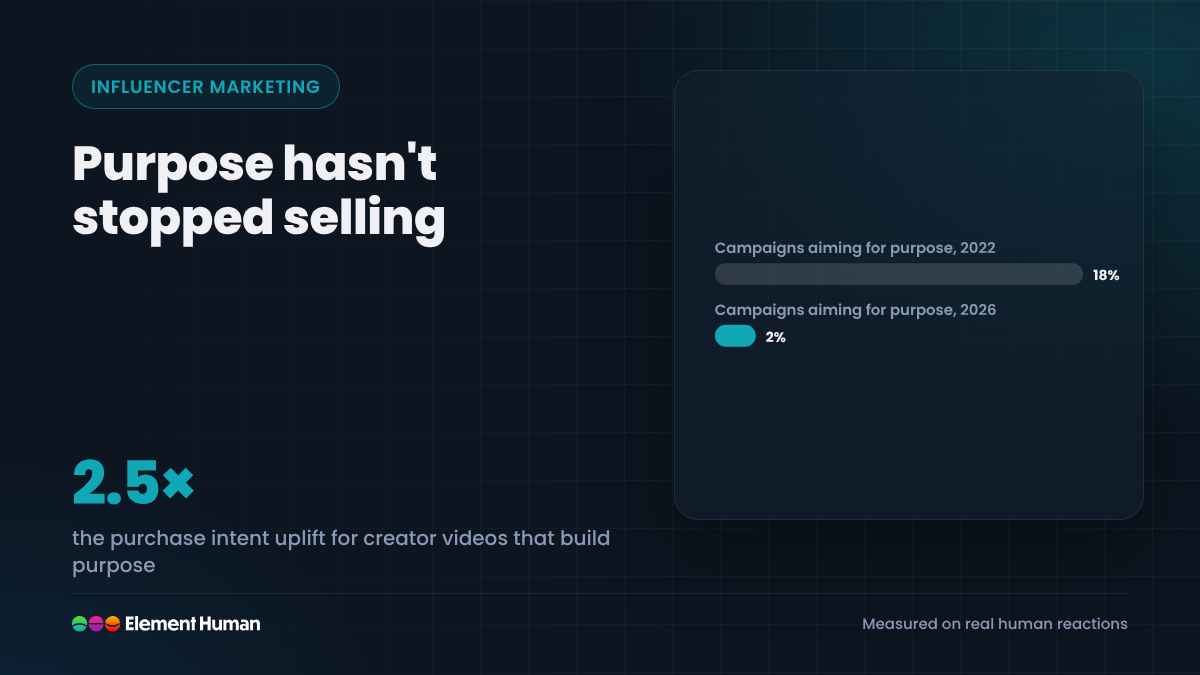
- In 2022, 18% of the creator campaigns we tested set out to build a sense of purpose. In 2026, it's 2%.
- Purpose here means sustainability, doing good and making a positive difference.
- Comparing each brand only with itself, creator videos that build a stronger sense of purpose deliver 2.5× the uplift in purchase intent.
- They also deliver 2× the uplift in favourability and 2.4× the uplift in recommendation.
- Purpose may have gone out of fashion in the brief, but it hasn't stopped selling.
It's Giving Tuesday next week. A good moment to ask what happened to brand purpose in creator marketing.
Every creator campaign we test measures the brand associations it sets out to build. Looking back over those briefs tells a clear story: purpose has all but disappeared.
Are brands still using creators to build purpose?
Hardly. In 2022, 18% of creator campaigns set out to build a sense of purpose: sustainability, doing good, making a positive difference. In 2026, it's 2%.
- Campaigns with a purpose objective18% to 2%
Source: Element Human creator campaign tests, brand associations measured with implicit association testing.
Does purpose still work in creator content?
Yes, and that's the shame of it. When creator content does land a purpose message, it works.
Comparing each brand only with itself, creator videos that build a stronger sense of purpose deliver:
- 2.5×the uplift in purchase intent
- 2×the uplift in favourability
- 2.4×the uplift in recommendation
Source: Element Human creator campaign tests, brand associations measured with implicit association testing.
Because each brand is only compared with itself, the gap isn't about which brands talk about purpose. It's about what the purpose message does when it lands.
Why has purpose dropped out of the brief?
Purpose may have gone out of fashion in the brief. It hasn't stopped selling. Brands have moved on to other messages, but the data shows the audience response to purpose is still there.
What should brands do with this?
- If your brand stands for something, say so. It might be worth asking your creators to show it.
- Make it land, not just appear. The uplift comes from videos that build a stronger sense of purpose, not from a line in the brief.
- Judge it on brand outcomes. Purchase intent, favourability and recommendation are where purpose pays back.
- Test it against your own content. Comparing a purpose-led video with your other creator videos shows whether the message is landing before you spend behind it, cutting waste on content that doesn't move people.
Purpose may have gone out of fashion in the brief. It hasn't stopped selling.
How we measured this
For this analysis we looked at the brand associations each creator campaign set out to build, and compared the share aiming for purpose in 2022 and 2026. We measured how strongly people linked each brand with purpose using implicit association testing, and compared each brand's creator videos only with that brand's other videos. Purchase intent, favourability and recommendation were measured as the uplift against a control group, with around 150 exposed viewers and 100 control viewers per test. Element Human also tests brand ads as well as creator content, across social feeds (TikTok, Instagram, Facebook and YouTube Shorts), CTV pre-rolls and sponsorships in simulated streaming environments, and standalone video such as TV ads. Every test compares an exposed group with a control group of people who did not see the content.
About the author
Hamish McPharlin is Chief Customer Officer at Element Human, where he helps brands prove and optimise the impact of their advertising. He previously worked at the BBC and CNN. Follow Hamish on LinkedIn.
Want to gather your own insights?
Ellie is your decision partner for marketing. Ask about attention, emotion and brand memory inside Claude, ChatGPT or Gemini Enterprise, and get answers from real human reaction data.
Try Ellie