Key Takeaways
- Across 192 beauty creator and branded social videos, emerging and established brands don't win the same way.
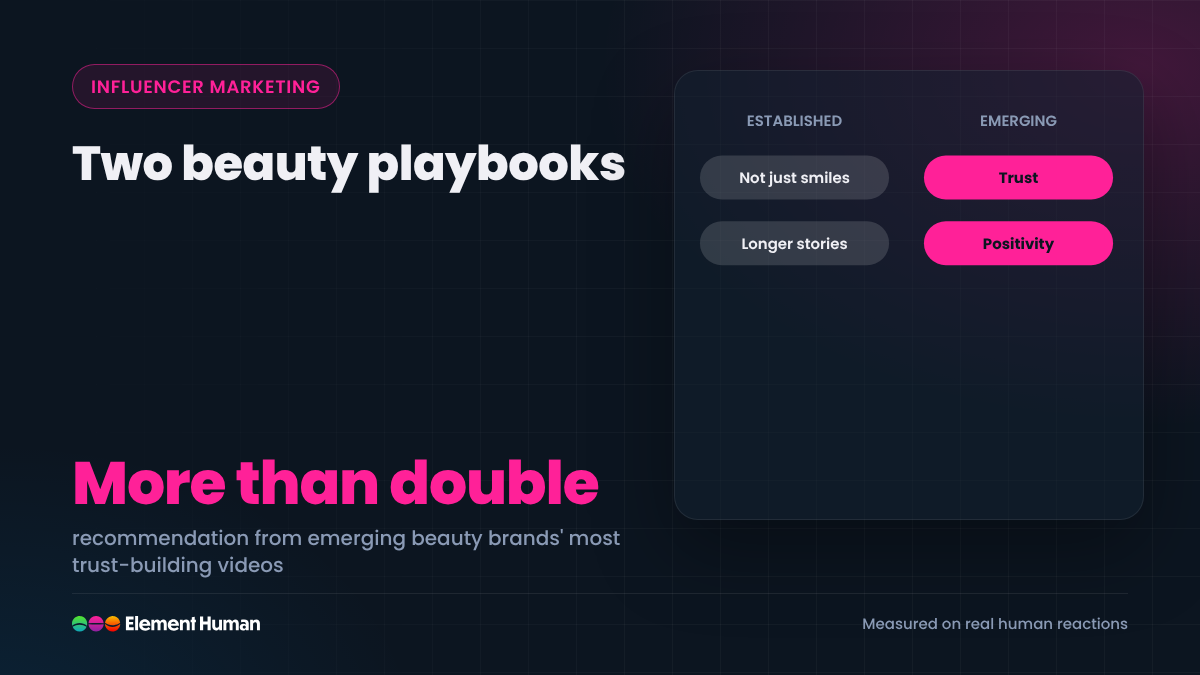
- For emerging beauty brands, trust is the job: the videos that build the most trust more than double recommendation.
- For emerging brands, storylines that evoke sadness, anger or disgust drop purchase intent by a third.
- Established brands' smiliest videos get noticed more, but sell less.
- Length works for established brands: longer videos hold attention without hurting purchase intent.
Big beauty brands and challenger brands are reading from the same creator playbook. They shouldn't be.
We looked at real human reaction to 192 beauty creator and branded social videos, measured with Element Human. The two groups don't win the same way.
- Emerging brandsEarn trust, keep it positive
- Most trust-building videos more than double recommendation
- Sadness, anger or disgust: purchase intent drops by a third
- Established brandsDon't rely on smiles, use length
- Smiliest videos get noticed more, but sell less
- Longer videos hold attention without hurting purchase intent
Source: Element Human tests of 192 beauty creator and branded social videos.
What works for emerging beauty brands in creator content?
Trust is the job. For emerging beauty brands, the videos that build the most trust more than double recommendation.
That makes sense. When people don't know a brand yet, the first thing a creator has to give them is a reason to believe it.
Positivity is the key to buyers' hearts. When storylines evoke sadness, anger or disgust, purchase intent drops by a third.
What works for established beauty brands?
Smiles aren't enough. Their smiliest videos get noticed more, but sell less.
Length works for them. Longer videos hold attention without hurting purchase intent, so established brands have room to tell a fuller story.
Why don't big and challenger brands win the same way?
They start from different places. An emerging brand still has to earn belief, so trust and a positive feeling do the heavy lifting. An established brand is already known, so a smile alone gets noticed without giving people a new reason to buy, while a longer story can hold them without costing purchase intent.
One playbook for both means at least one of them is briefing for the wrong job.
What should beauty brands do with this?
- Know which brand you are. Think about the strategies that unlock impact for your brand size before you brief your next creator.
- Emerging brands: brief for trust. The most trust-building videos more than doubled recommendation.
- Emerging brands: keep the storyline positive. Sadness, anger or disgust cut purchase intent by a third.
- Established brands: don't stop at a smile. The smiliest videos got noticed but sold less.
- Established brands: use the time. Longer videos held attention without hurting purchase intent.
How we measured this
For this analysis we looked at 192 beauty creator and branded social videos, splitting emerging and established brands. We measured attention and emotion while people watched, using facial coding for emotion, and trust, recommendation and purchase intent as the uplift against a control group, with around 150 exposed viewers and 100 control viewers per test. Element Human also tests brand ads as well as creator content, across social feeds (TikTok, Instagram, Facebook and YouTube Shorts), CTV pre-rolls and sponsorships in simulated streaming environments, and standalone video such as TV ads. Every test compares an exposed group with a control group of people who did not see the content.
About the author
Hamish McPharlin is Chief Customer Officer at Element Human, where he helps brands prove and optimise the impact of their advertising. He previously worked at the BBC and CNN. Follow Hamish on LinkedIn.
Want to gather your own insights?
Ellie is your decision partner for marketing. Ask about attention, emotion and brand memory inside Claude, ChatGPT or Gemini Enterprise, and get answers from real human reaction data.
Try Ellie