Key Takeaways
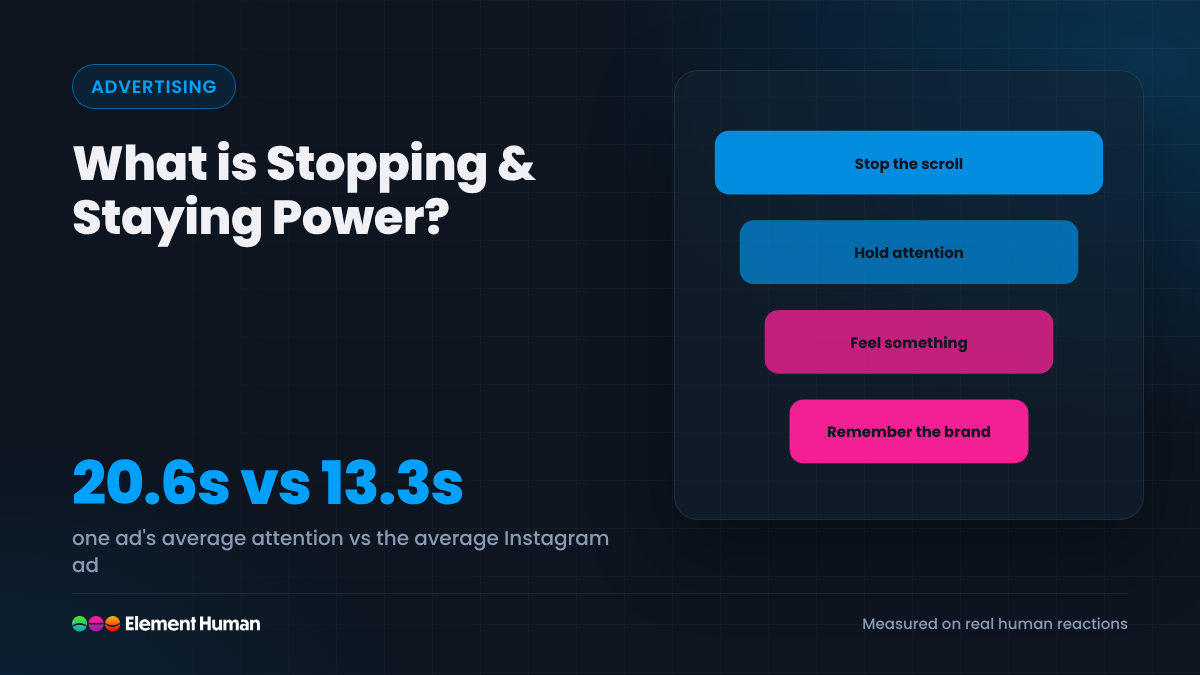
- Stopping Power measures whether an ad stops the scroll, using second-by-second attention in a lifelike feed.
- Staying Power measures whether the brand sticks, using a timed implicit association test called the "Fast Yes".
- One recent ad held people for 20.6 seconds on average, against 13.3 seconds for the average Instagram ad.
- Plotting both gives four quadrants. The top right, seen and remembered, is where you want your ads to be.
- It is a practical diagnostic for which creatives to upweight or downweight during a campaign.
Attention has become the default currency of social advertising. But attention on its own only tells you that people looked. It doesn't tell you whether they walked away remembering your brand.
Stopping & Staying Power goes further than attention. It's my favourite tool in campaign optimisation, because it answers the two questions that actually matter for building a brand in the feed.
What is Stopping Power?
Stopping Power is whether your ad stops the scroll. We track, second by second, who keeps the ad on screen in a lifelike feed, where it appears among other posts just as it would on the real platform.
That gives a realistic read on attention. One recent ad held people for 20.6 seconds on average, against 13.3 seconds for the average Instagram ad.
- Average attention+55%
Source: Element Human Stopping Power data, Instagram feed tests.
What is Staying Power?
Staying Power is whether your brand sticks. After people see the ad, a timed reaction test shows how much faster they link your brand to the right traits than people who didn't see it. We call that the "Fast Yes".
Speed matters because it reflects what is already in long-term memory. A slow, considered yes is a guess. A fast yes is an association the brand owns.
How do you read the Stopping & Staying Power chart?
Plot every ad on both measures and you get four quadrants.
- Top right: seen and remembered. The ad stops the scroll and builds the brand. Upweight these.
- High stopping, low staying: seen but not credited. People watch, but the brand doesn't stick. Often the brand is missing from the moment people enjoy.
- Low stopping, high staying: remembered, by fewer people. The ad works on those who watch, but needs a stronger opening to reach more of them.
- Bottom left: neither. Candidates to cut or rework.
How do you use it to optimise a campaign?
Use it as a diagnostic for which creatives to upweight or downweight, based on their actual effectiveness at building the brand in the social feed.
- Score every creative, including every creator video, not just the hero ad.
- Shift budget towards top-right creatives while the campaign is live.
- Fix the weaker job on the rest: a sharper opening for low stopping power, better brand integration for low staying power.
- Brief the next round from what the top-right ads have in common.
Which of your ads does both? That's the question worth asking before you spend the next dollar.
How we measured this
Stopping Power is measured as attention in feed (dwell time) in Element Human's simulated social feeds, where the ad is placed at a random position in a scrolling feed. Staying Power is measured with an implicit association test (the "Fast Yes"), randomised with decoy brands and compared against a control group, with around 150 exposed viewers and 100 control viewers per test. Element Human also tests brand ads as well as creator content, across social feeds (TikTok, Instagram, Facebook and YouTube Shorts), CTV pre-rolls and sponsorships in simulated Netflix and Prime Video environments, and standalone video such as TV ads. Every test compares an exposed group with a control group of people who did not see the content.
About the author
Hamish McPharlin is Chief Customer Officer at Element Human, where he helps brands prove and optimise the impact of their advertising. He previously worked at the BBC and CNN. Follow Hamish on LinkedIn.
Want to gather your own insights?
Ellie is Element Human's AI connector. Ask it about attention, emotion and brand memory, and get answers from real human reaction data.
Try Ellie