Key Takeaways
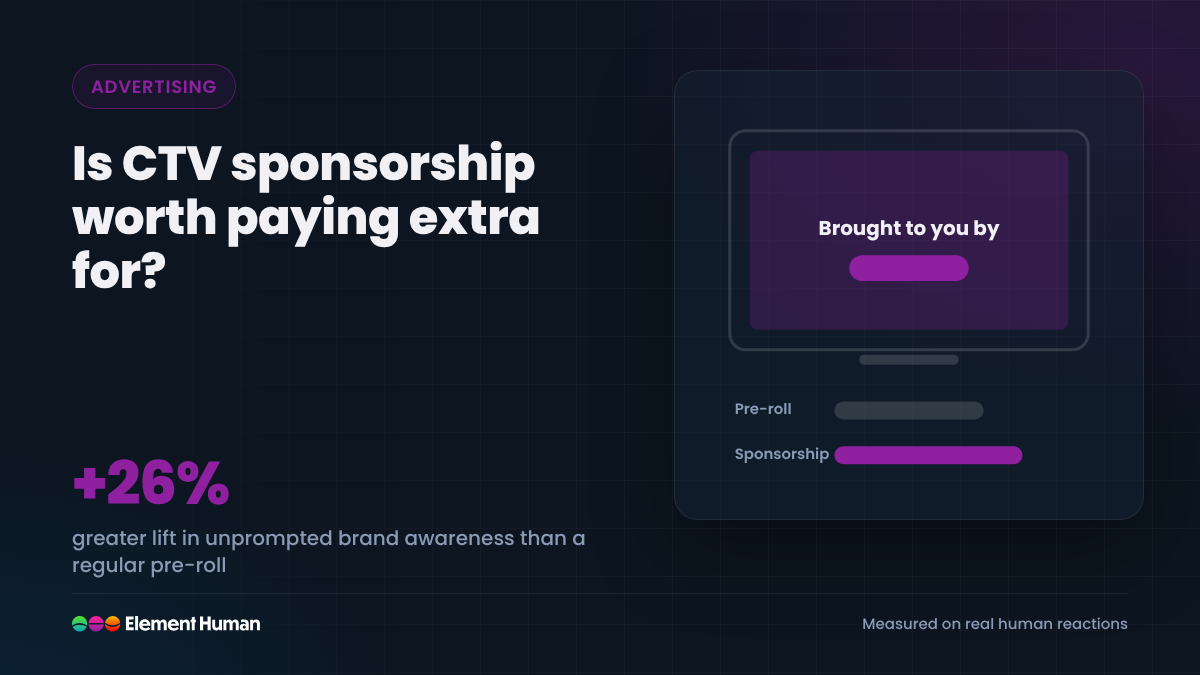
- CTV sponsorship drives a 26% greater lift in unprompted brand awareness than a regular pre-roll.
- Viewers show 28% greater positive emotion when a brand sponsors the show they chose to watch.
- That emotional lift feeds into stronger messaging impact and brand consideration further down the funnel.
- If the aim is pure awareness, a run-of-site pre-roll can do the job.
- If you need brand building, sponsorship delivers more mid-funnel impact.
Sponsorship on connected TV usually costs more than a standard pre-roll. So the question every media planner asks is a fair one: is it worth paying extra for?
According to our CTV measurement, when the goal is brand building, the answer is yes. Sponsorship has a clear edge over a regular pre-roll.
What is the difference between CTV sponsorship and pre-roll?
A pre-roll is an ad that plays before the programme a viewer has chosen. A sponsorship, such as a single title sponsorship, ties the brand to that specific show, usually with a short sponsor bumper or ident around the content.
Both reach the viewer at the same moment, just before the show starts. The difference is the relationship: a pre-roll interrupts the show, while a sponsor is part of it.
Does CTV sponsorship drive more brand awareness?
Yes. Sponsorship drives a 26% greater lift in unprompted brand awareness than a regular pre-roll.
- Unprompted brand awareness lift+26%
- Positive emotion+28%
Source: Element Human CTV tests in simulated streaming environments. Sponsorship = a brand sponsoring the show the viewer chose to watch.
Unprompted awareness is the hardest awareness measure to move. People have to name the brand themselves, without a list to pick from. A bigger lift here means the brand is more firmly in people's minds.
Does sponsorship make people feel more positive about the brand?
Yes. Viewers show 28% greater positive emotion when a brand sponsors the show they chose to watch.
We measure this with facial coding while people watch. The likely reason is simple: the brand is attached to something the viewer actively picked and is looking forward to, rather than standing between them and it. That positive feeling has a downstream effect on messaging impact and brand consideration.
When is a pre-roll enough?
If your aim is pure awareness, a simple run-of-site pre-roll can do the job. It is efficient at putting the brand in front of people.
But if you need brand building, sponsorship delivers greater mid-funnel impact, and with it longer-term effects.
How to decide between sponsorship and pre-roll
- Start with the objective. Reach and awareness: pre-roll. Brand building and consideration: sponsorship.
- Pick shows that fit the brand. Sponsorship borrows the feeling viewers have for the programme, so choose programmes your audience loves.
- Measure beyond reach. Track unaided awareness, emotion and consideration, not just impressions, to see what the premium buys.
How we measured this
For this analysis we compared CTV sponsorships with regular pre-rolls tested in Element Human's simulated streaming environments (Netflix and Prime Video). In the pre-roll test, viewers choose an episode from a programme page, the pre-roll plays, then about two minutes of the programme. In the sponsorship test, viewers choose a programme, see the sponsor bumper, then about one minute of the programme. Emotion is measured with webcam-based facial coding; awareness by survey against a control group. Element Human also tests brand ads as well as creator content, across social feeds (TikTok, Instagram, Facebook and YouTube Shorts), CTV pre-rolls and sponsorships in simulated Netflix and Prime Video environments, and standalone video such as TV ads. Every test compares an exposed group with a control group of people who did not see the content.
About the author
Hamish McPharlin is Chief Customer Officer at Element Human, where he helps brands prove and optimise the impact of their advertising. He previously worked at the BBC and CNN. Follow Hamish on LinkedIn.
Want to gather your own insights?
Ellie is Element Human's AI connector. Ask it about attention, emotion and brand memory, and get answers from real human reaction data.
Try Ellie