Key Takeaways
- Some agencies and brands now use AI to give creatives a pass or fail grade against best-practice guidelines.
- By those guidelines, one of the most celebrated ads ever made would have been left on the cutting room floor.
- Best-practice rules describe what usually works. Breakthrough ads often work because they break the rules.
- AI is most useful when it is grounded in how real people actually respond, not in a checklist.
- Test with real human reactions before a robot decides what a human audience will feel.
AI is now being used by some agencies and brands to decide which creatives run. The tools give each ad a pass or fail grade based on a set of best-practice guidelines: brand in the first few seconds, logo on screen, product early, and so on.
It's fast and cheap. But is getting a robot to decide whether an ad will work for a human audience a useful exercise?
Would great ads pass an AI checklist?
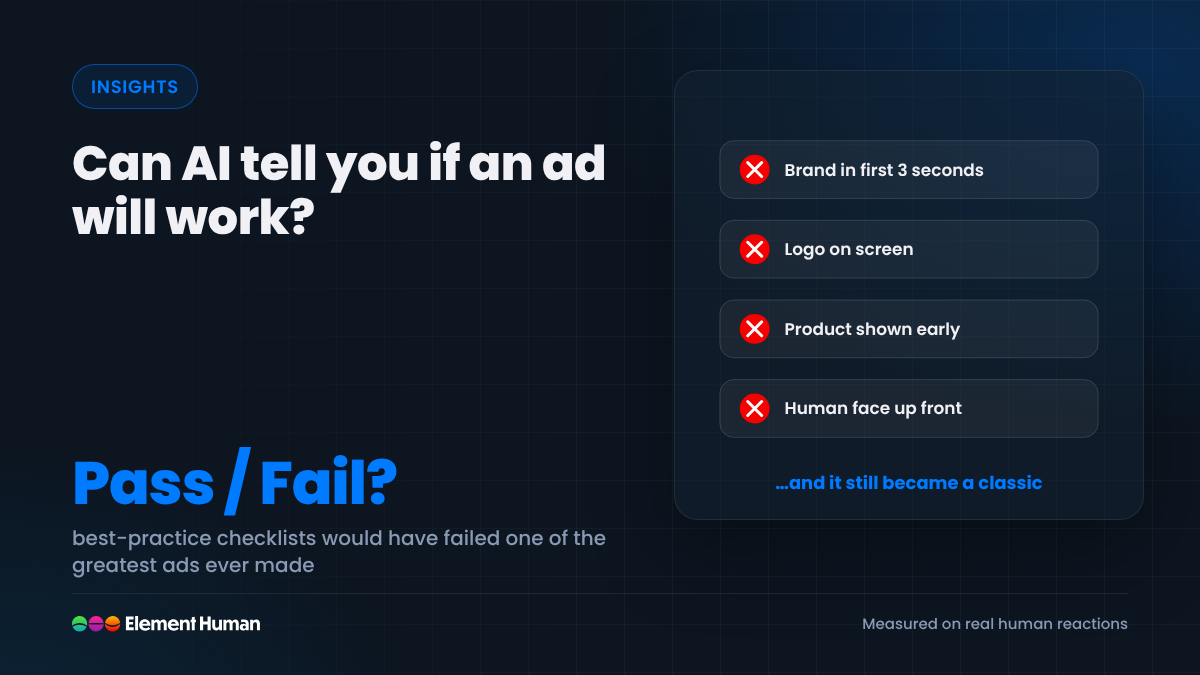
Not always. Looking through these guidelines, I realised that one of the all-time greatest ads, a chocolate ad starring a drumming gorilla, would have been given a fail grade and left on the cutting room floor.
- ✕Brand in the first few seconds
- ✕Logo on screen
- ✕Product shown early
Verdict: fail. Yet people still talk about it years later.
It breaks the rules: nothing about it looks like a typical product ad. Yet it is the kind of work people still talk about years later.
Why do best-practice rules miss breakthrough creative?
Because rules describe what usually works on average. The ads that stand out often do so precisely because they're different from the average. A checklist rewards the familiar, and the familiar blends into the feed.
What makes an ad work is how people feel and what they remember afterwards. A checklist can't watch the ad. People can.
Is there a role for AI in ad testing?
Yes, when it's grounded in real human data. AI is very good at finding patterns, comparing results across thousands of tests and answering questions quickly. That's how we use it with Ellie, our AI assistant, which answers marketing questions from Element Human's measured data on real human attention, emotion and memory.
The difference is the source. A prediction built on how real people reacted is evidence. A grade built on a list of rules is an opinion.
What does a creator effectiveness expert say?
We asked Simon Harwood, Global Effectiveness Director at Billion Dollar Boy, how his team handles AI pre-testing tools. His answer: use them as a safety net, not a recipe.
“The tools that are available to essentially review creative content before it goes live, or even as it’s just gone live and in flight, are becoming really sophisticated… [they] can actually predict the likelihood that it’s going to be seen, remembered and thought of in the future.”
Simon Harwood, Elementally Human Episode 10, watch at 19:35
But he sees them as a minimum bar, not a guide to making the work:
“Not in terms of a guide book for crafting the content, but more of a minimum standard. So, a certain threshold. It’s good to have it as a fail safe to make sure that we’re not creating content that’s just going to get absolutely unnoticed.”
Simon Harwood, Elementally Human Episode 10, watch at 20:05
Follow the rules too closely and you end up with average work, and average doesn’t survive in a creator feed:
“It’s really important to know what the best practice rules are but not be governed by them… because that is the quickest way to essentially shortcut to average, and average just doesn’t get noticed.”
Simon Harwood, Elementally Human Episode 10, watch at 21:06
“It’s great having the science to decode why a piece of work worked and also to set some minimum standards, but you can’t build a piece of entertaining, memorable content through science alone.”
Simon Harwood, Elementally Human Episode 10, watch at 22:28
How to use AI tools for creative decisions
- Use checklists as a prompt, not a verdict. They can flag obvious problems but shouldn't kill an idea on their own.
- Test bold work with real people. Especially the ideas that break the rules.
- Ask what an AI tool is trained on. Rules, or measured human response?
Steph Money and I put this question to Simon Harwood in Episode 10 of Elementally Human, our video series on YouTube. The AI discussion starts at 18:33. What’s your experience?
How we measured this
Element Human measures how real people respond to video ads, using webcam eye tracking and in-feed attention, second-by-second facial coding of emotion, and implicit association testing of brand memory, with around 150 exposed viewers and 100 control viewers per test. Element Human also tests brand ads as well as creator content, across social feeds (TikTok, Instagram, Facebook and YouTube Shorts), CTV pre-rolls and sponsorships in simulated Netflix and Prime Video environments, and standalone video such as TV ads. Every test compares an exposed group with a control group of people who did not see the content.
About the author
Hamish McPharlin is Chief Customer Officer at Element Human, where he helps brands prove and optimise the impact of their advertising. He previously worked at the BBC and CNN. Follow Hamish on LinkedIn.
Want to gather your own insights?
Ellie is Element Human's AI connector. Ask it about attention, emotion and brand memory, and get answers from real human reaction data.
Try Ellie