
Attention sparks. Emotion connects. Memory drives decisions.
Marketing teams face a recurring choice: test creative and measure impact in the wild (natural exposure), in controlled labs, or in simulated environments that replicate real platforms at scale. Each approach promises different insights, but only one delivers the truth about what people feel and remember.
Key Takeaways
- Testing in simulated real-world environments produces significantly more accurate behavioral data than traditional survey links
- Element Human measures second-by-second emotion, attention, and memory to reveal what truly drives audience behavior
- Behavioral data provides a more complete picture of content effectiveness than self-reported survey responses
- Understanding audience emotion before investing in media placement saves budget and improves campaign ROI
- Second-by-second measurement reveals exactly when and why audiences engage or disengage with content
This isn't about what people say, it's about what their brains do in those critical milliseconds when real brand impact happens.
The Hidden Problem: You're Measuring the Wrong People
Natural exposure looks efficient because your content runs where it will eventually live. But here's what traditional research won't tell you: platform algorithms don't optimize for representativeness. They optimize for engagement.
What This Bias Actually Looks Like
The Vocal Minority Problem
Related reading: The Big Shift in TV Viewing Habits · The CTV Opportunity: Helping Brands See What's Missing
- Super users, enthusiasts, and heavy engagers see more of your content
- These aren't your typical buyers, they're younger, more price-sensitive, trend-driven
- They click, comment, and engage, but they don't represent real purchasing behavior
The Silent Scrollers Gap
- High-value customers consume content passively
- They notice, process emotionally, remember, and buy later
- They never signal in-platform, so natural exposure misses them entirely
The Over-Optimization Trap
- Optimizing solely on engagement metrics sands off persuasion and message clarity
- You risk shipping clickbait that doesn't drive actual brand lift
Real Example: Two video cuts perform similarly on likes and comments. In simulated testing, Cut A drives 12-15% higher ad recall and emotional connection among passive viewers, who are actual buyers. Natural exposure would have led you to pick the weaker creative or suggest that the campaign performed better, or worse, than it actually did.
The Testing Spectrum: Where Each Method Fits

Lab-Based: Rich Insights, Heavy Logistics
Labs bring participants into controlled settings where they navigate real platforms while researchers observe behavior. The trade-offs are significant:
Strengths:
- High control of context and exposure
- Rich qualitative feedback and behavioral observation
- Useful for usability studies and complex journey mapping
Critical Limitations:
- Not fast: Recruiting, scheduling, and moderating stretches timelines to weeks or months
- Not scalable: Small sample sizes limit statistical power for brand-lift measurement
- Observer effect: Being watched changes behavior—people don't act naturally
- Cost-prohibitive: Facility costs, incentives, and specialized equipment add up quickly
Bottom line: Valuable for deep diagnostics, but not for fast, scalable creative optimization.
Natural Exposure: The "Real World" That Isn't Representative

Natural exposure runs ads live on platforms and measures through engagement signals. While this mirrors actual delivery, it creates more problems than it solves:
The Dirty Secret of "Natural-First" Providers
Even providers who claim to run "natural-first" research routinely fall back on simulated environments to meet deadlines and fill quotas. Here's why:
- Quota inefficiency: Precise audience targeting leads to slow fill rates and over-delivery of impressions
- Platform volatility: Algorithm changes and inventory shifts derail timelines
- Creator complexity: Influencers become research recruiters, requiring additional contracts and approvals
- Limited reach: Can't test CTV, streaming, or display—entire campaign types are out of reach
The result: Most natural exposure projects get supplemented with simulation anyway. Planning for simulation from the start gives you better control and outcomes.
Simulated Environments: Where Science Meets Scale
Simulated environments combine the realism of actual platforms with the scientific rigor research demands. You recruit target audiences, assign them to controlled conditions, and measure what truly drives decisions.
The Element Human Advantage

What You Actually Measure
System 1 Signals (What Drives Decisions):
- Attention patterns and viewability duration
- Emotional response through facial coding
- Memory encoding via implicit association testing
- Subconscious brand connections
Actionable Outcomes:
- Ad and brand recall lift
- Message comprehension and attribute association
- Consideration and purchase intent shifts
- Creative diagnostics by scene, frame, or moment
Head-to-Head: The Real Comparison
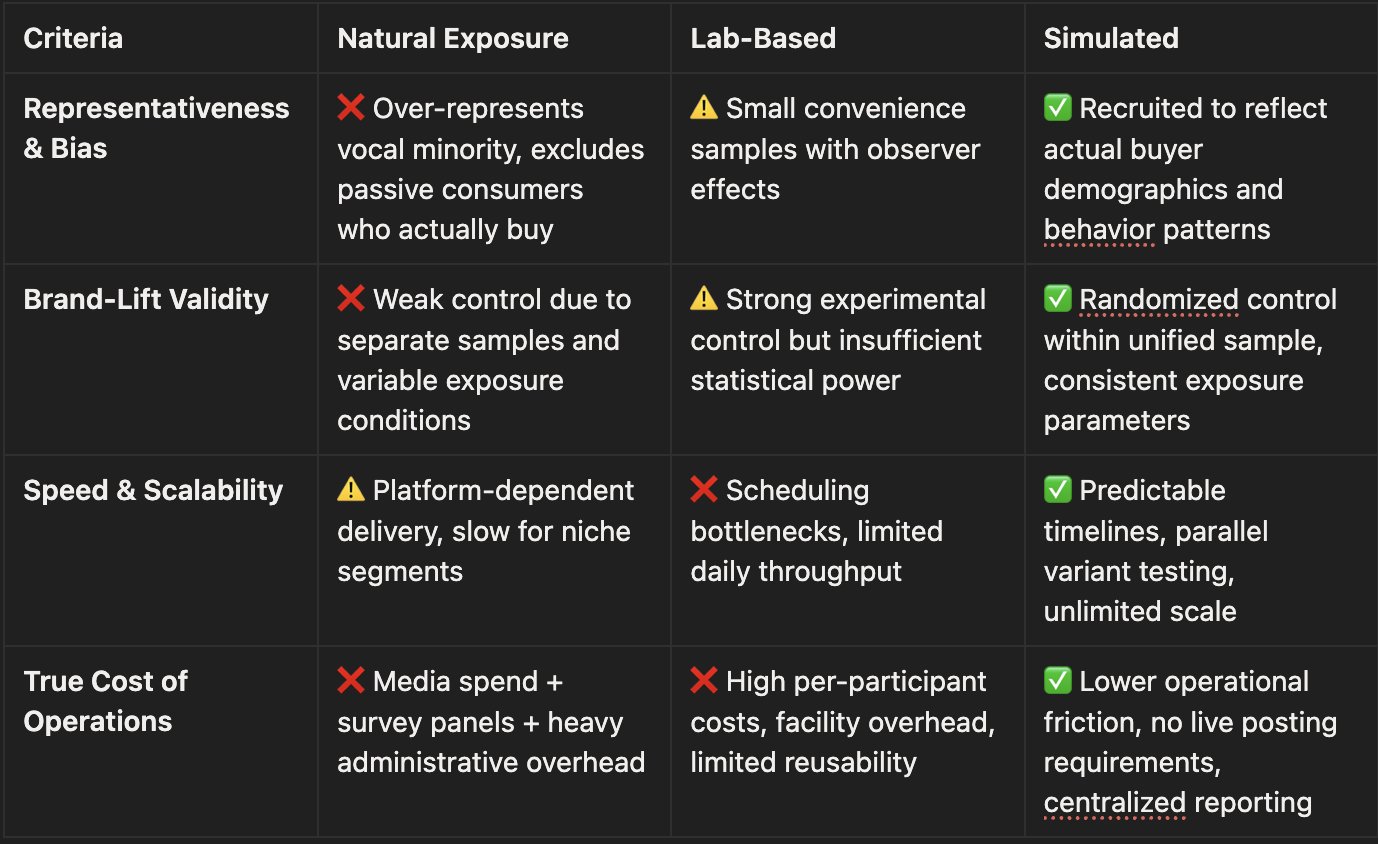
The Hidden ROI: Operational Relief
Time and attention are your scarcest resources. Simulated environments reduce overhead across the board:
For Creators:
- Deliver assets once—no live platform paperwork or content approvals
- No complex disclosure management or usage rights negotiations
For Agencies:
- Skip juggling multiple platform placements and reporting dashboards
- Avoid data stitching between exposure and measurement systems
- Get consistent, comparable results across all campaigns
For Stakeholders:
- Faster readouts enable more test-learn cycles before media goes live
- Standardized metrics and benchmarks simplify decision-making
Those saved cycles compound into better creative outcomes—which usually delivers more impact than one slow, "perfect" study.
Your Strategic Playbook
Use Simulated When You Need:
- Fast, reliable brand-lift measurement and creative selection
- Pre-flight testing across multiple channels (CTV, social, product placement)
- Message validation and audience comparison studies
- Iterative optimization with tight feedback loops
Use Lab-Based When You Need:
- Deep qualitative insight and behavioral observation
- Usability diagnostics for complex user journeys
- Rich think-aloud feedback for creative development
- Pair with simulation for both "why" and "how much"
Use Natural Exposure When You Need:
- Real-time social proof for live campaigns
- Platform-native optimization within existing metrics
- Validate simulation winners before scaling media spend
Implementation: Your Simulation-First Research Stack
1. Define Success Metrics Prioritize System 1 signals: recall, emotional connection, and intent alongside attention metrics.
2. Set Sampling Rules Recruit actual buyers and category users, not just heavy platform engagers.
3. Control for Clean Insights Standardize frequency, sequencing, and context to isolate creative effects.
4. Test Variants in Parallel Run A/B/C tests to maximize learning per fielding cycle.
5. Close the Feedback Loop Feed insights into creative revisions, then verify improvements with rapid re-testing.
6. Complement Strategically Add targeted lab sessions for qualitative depth on winning concepts. Monitor natural exposure once live for media optimization.
Common Objections, Real Answers
"Simulation isn't realistic enough." High-fidelity simulated feeds mirror layout, pacing, ad load, and natural interruptions. For measuring what people feel and remember, the gain in scientific control and sample quality far outweighs minor differences from live delivery.
"We need platform engagement signals." Keep them for in-flight optimization. Use simulation to confirm creative actually persuades and creates lasting memory. Then let platform algorithms distribute it efficiently to the right audiences.
"Our stakeholders expect 'in-market' data." Give them both: simulation for causal brand-lift measurement, plus lightweight natural exposure for directional engagement validation. This hybrid approach reduces wasted spend while accelerating learning cycles.
The Benchmark Advantage: Your Competitive Intelligence Engine
Here's what traditional research can't give you: context. With simulated environments, you control the survey instrument, which means you can build comprehensive benchmarks across platforms, industries, and markets.
What This Unlocks:
- Compare your CTV creative performance against category leaders
- Benchmark emotional response across TikTok vs. Instagram vs. YouTube
- Track how your brand memory scores stack against competitors over time
- Identify which platforms drive strongest attention for your specific audience
This isn't just measurement—it's competitive intelligence that informs strategy. Natural exposure can't deliver this because each platform uses different metrics. Lab testing can't scale it. Only controlled simulation gives you consistent, comparable data that builds into a strategic asset.
Make Simulated Your Strategic Advantage
If your goal is to create content that doesn't just perform but truly connects, simulated environments reveal what others miss. Natural exposure overweights the vocal few and muddies brand-lift with fragmented data. Lab testing adds valuable depth but can't scale insights across variants and audiences fast enough.
Transform your measurement approach:
Phase 1: Foundation (Month 1)
- Establish baseline benchmarks across your key platforms and competitors
- Build your System 1 measurement framework (attention + emotion + memory)
- Create standardized testing protocols for ongoing optimization
Phase 2: Integration (Months 2-3)
- Make simulation your default pre-flight testing method
- Use benchmark data to set performance thresholds and targets
- Build feedback loops between creative teams and measurement insights
Phase 3: Optimization (Ongoing)
- Continuously expand your benchmark database across categories and channels
- Use competitive intelligence to inform creative strategy and media planning
- Scale successful patterns across campaigns using proven System 1 drivers
Start Building Your Benchmark Advantage Today
Your Implementation Roadmap:
- Launch your first benchmark study across 3-5 key competitors this month
- Establish baseline metrics for attention, emotion, and memory across your priority platforms
- Create ongoing testing protocols that feed competitive intelligence back into creative development
- Scale systematically by adding new platforms, markets, and creative formats to your benchmark database
The compound effect: Every simulation builds your competitive intelligence. Every benchmark gives you strategic advantage. Every insight drives better creative decisions.
Ready to stop guessing and start knowing what moves your audience? Your benchmark-driven measurement transformation starts with one simulation.
[Start Your Benchmark Study] → [Book Strategy Call] → [View Platform Demo]